|
||||||||||||||
|
||||||||||||||





| * - we will add information as it becomes available. | ||||||||
Compiled and edited by Roger A. Hill 19 November (Sunday)
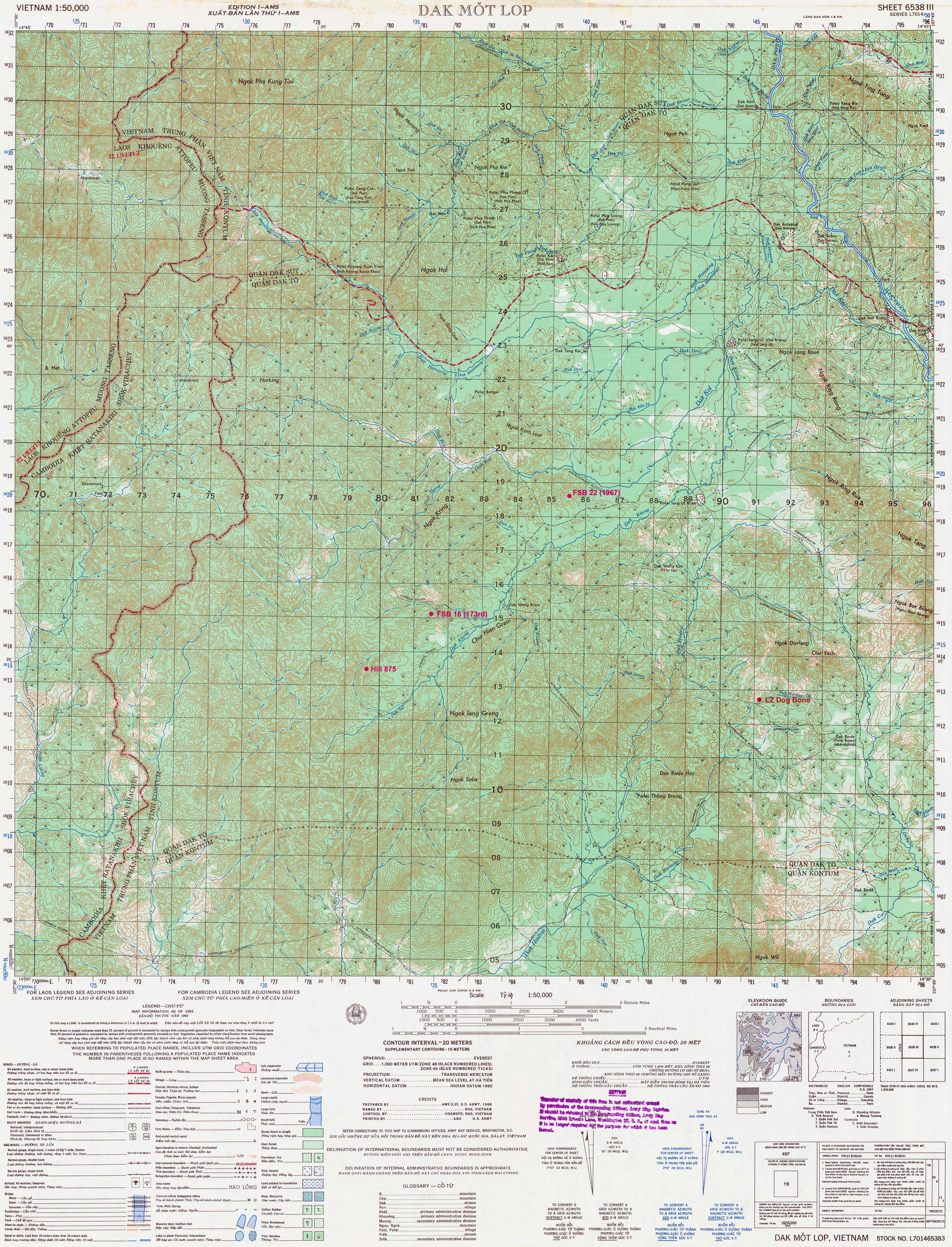
On 19 November 1967, about a week before Thanksgiving, the 1st Battalion, 12th Infantry Regiment is conducting operations just north of the Me Wal Plantation, approximately 15 kilometers north of Ban Me Thuot. During the day, Captain Bruce R. Black replaces Captain Robert L. Sheldon as the battalion’s S-4 officer, and the Recon Platoon is inserted into a patrol area near the Oasis for the beginning of a two-week-long operation. Some time during the early evening hours, the battalion commander receives orders to move the battalion the next day by Air Force transport planes from its location in the Ban Me Thuot area up to the Dak To Airfield to join the 1st Brigade and to assist in the fighting that was going on near Dak To. The 1st Brigade had been in heavy and continuous contact with the enemy for several weeks. It had been recently reinforced by the 173rd Airborne Brigade, which had been thrown into the thick of the fighting on Hill 875 and had suffered horrendous casualties (Birch:1, Long:1, Phillips:7, Schneider:7).
20 November (Monday)
Upon arrival at Dak To Airfield, Alpha and Delta Companies are attached to the 173rd Airborne Brigade as Task Force Long for Operation MacArthur, while the remainder of the battalion (Bravo and Charlie Companies and the Recon Platoon) occupies a portion of the perimeter at the Dak To Airfield and conducts local patrolling. Task Force Long, commanded by the battalion’s executive officer, Major George Long, then moves by motor convoy to the 173rd’s forward operations base, which has been designated as Fire Base 12, and closes by 1845. Shortly after the battalion is established at the Dak To airfield, the battalion trains is relocated and sets up its forward operations there also (Dilkes:169-170, Phillips:7, Schneider:17, 20).
Major Long records in his After Action Report, “Accordingly, at first light the next morning, the battalion began breaking down its fire support base in preparation for the move. The move was made from that location by CH-47 and UH-1H aircraft, into the East Ban Me Thuot airfield. The [battalion’s] equipment was then palletized and made ready for C-130 airlift up to Dak To. The first flights got off around 1300 hours with Companies A and D.” Colonel Harold (“Hal”) Birch recalls, “We landed on the steel-matted air strip in Dak To. The scene from the cockpit, as we landed, was enough to shake the stoutest of hearts. Two Air Force transports lay along side the strip--one still burning, the other a burned-out hull. The men in the cargo bays had no windows and were spared this sight until they deplaned. But I was anxious that my battalion be unloaded before one in the line of a half dozen Air Force planes was struck by enemy fire.”
Colonel Birch continues, “On landing, I was immediately told to climb on a chopper that was waiting for me and report to the 173rd Airborne Brigade Headquarters located at the Ben Het Special Forces Camp [Detachment A-244]. It was on a narrow road quite near the Laotian border. Two companies (A and D) of the 1/12 Infantry were to follow shortly thereafter by ground convoy escorted by a company of tanks. The remainder of the battalion was to follow some time later. Instead of going to the 1st Brigade of the 4th Division, we were placed under operational control of the 173rd Airborne Brigade.
“When I reported to the Airborne Brigade, commanded by Brigadier General Leo H. Schweiter, he told me I was to combat assault my two companies into a small landing zone (LZ) that would be secretly cut in the jungle for them that night by a Special Forces team employing Civilian Irregular Defense Group (CIDG) troops. The small LZ would hold only two choppers at a time, and this could be a serious problem as an enemy could block our efforts by hitting one or both of the choppers, trapping the force already landed. Circumstances had decided that the two companies to be used were A Company under Captain Larry Cousins, and D Company under Captain George Wilkins.
“Airborne troops were in position on the north edge of Hill 875. Extensive Air Force and Army gun-ship air strikes, followed by heavy artillery preparatory fires, were planned for the morning of the attack. Immediately on landing, the two companies from the 1/12 Infantry were to be under the command of one of the airborne battalion commanders, Lieutenant Colonel James H. Johnson.
“His battalion, the 4/503rd, with the 1/12's help, was to take Hill 875 on Thanksgiving morning. This would be the third effort at taking that hill. In the other unsuccessful attacks by the Airborne, they had suffered heavy casualties. In fact, casualties in the fighting to this point in the battle around Dak To and Hill 875 had been so high that my two 1/12th Companies had more infantrymen in them than the whole [remaining] Airborne Brigade.”
John Beckman, a rifleman in Delta Company recalls that, “When we arrived at Dak-To and got off the planes, we were all ushered into a ditch-like area near the airstrip and were divided into groups based on our religious preferences. Being Catholic, I went to an area where there was a priest who administered us our Last Rites (not exactly a pleasant thought, as fear ran through us as to what we must be getting into). When we looked around the Dak-To Airfield, we could see evidence that there had been some pretty intense enemy activity here recently. A C-130 lay in the ditch across the way from us, and no one was up and just walking around; everyone would run from bunker to bunker.
“As soon as we were able to get our equipment off of the aircraft, we were loaded onto deuce-and-a-halves and were trucked out to a 173rd Airborne firebase some distance from the Dak-To Airfield. Along the way we passed some local Vietnamese who wanted us to throw them C-rations. The guys in my truck started tossing out a few cans, and when one boy caught one, he quickly threw it back. It was the “well-liked,” but dreaded, can of Ham and Eggs! When we arrived at the firebase, they moved us to a small hill outside the main perimeter to spend the night. With the high level of alert status in the area, no one got very much sleep that night. And no one knew why we had to spend the night outside that large, much more secure firebase.”
Major Long continues, “[We] arrived around 2030 . . .. [Because] it was after dark when we landed . . . [it was necessary] that the runway was light by fire barrels filled with [a mixture of] five gallons of diesel and gasoline. I was met on the ground by LTC Birch, the battalion commander, who informed me that Companies A and D had already been lifted by helicopter to the 173rd Brigade FSB and were OPCON to them. The 173rd Brigade FSB was approximately 15 kilometers to the west of Dak To. At this point he informed me that I was to command the TF, which was to conduct a supporting attack on Hill 875, YB 796135, in the near future . . ..”
21 November (Tuesday)
Day Two of the battalion’s OPCON status to the 173rd Airborne is filled with a multitude of last minute coordination between the two major commands and with preparations for the upcoming assault by the Task Force, both at battalion and company levels. Colonel Birch relates, “I was to be taken on an aerial reconnaissance of the landing site [for the Task Force] by the Brigade Executive Officer (XO), a full Colonel, and afterwards we stopped to coordinate with LTC Johnson. Before leaving Ben Het for this reconnaissance, I had told my XO, Major George Long, that he was to command the two companies that were to be designated as a ‘task force’ (Task Force Long). To help him control the TF, he was to take two of the battalion staff officers, the operations sergeant, several other radio operators, and the artillery liaison officer and his own RTO.”
Major Long talks about his preparations this day. “I made three separate aerial reconnaissance’s and was able to get quite close to Hill 875 and see the 503rd airborne locations, our landing zone that we were to go in on, and the hill and the surrounding country pretty well. During this period there was a coordination conference, which I attended with the battalion commander of the 4th Battalion, 503rd Airborne at his fire support base. Instructions received by me at this time were that the TF that I was to command would conduct a combat air assault into an LZ, which was on the south side of Hill 875 at YB 797128. Artillery and air support would be flown in preparation for the air assault. This artillery and air support were to be going in on Hill 875. The artillery and air strikes were to be controlled by the 2nd Battalion of the 503rd Airborne, who were in position on the north slope of Hill 875.
“The 4th Battalion, 503rd Airborne were preparing to relieve the 2nd Battalion, since the 2nd Battalion had taken rather heavy casualties. Task Force 1st Battalion, 12th Infantry was to conduct a supporting attack on the south slope of Hill 875. We were given a limit of advance, which was located about 300 meters due south from the crest of Hill 875. Mobile Strike Force 26 was already on the ground and had been given the mission to prepare and secure the LZ for our combat assault. Then immediately following the combat assault this force, company, would become OPCON to TF 1st Battalion, 12th Infantry. That evening, preparations were made by issuing extra ammunition to Companies A and D, and approximately 25 LAWS were secured and issued to use against bunker complexes which we had been told were up on Hill 875.”
John Beckman remembers that, “The next morning we began preparing our equipment and getting additional issues of ammo, C-rations, and any other equipment we might need to get up Hill 875. In the afternoon we were briefed about the next day’s airlift onto Hill 875; who was going to go first and what to expect. Because of all the fighting on Hill 875, the howitzers in the nearby firebase were constantly firing in support of the units on the hill. Most of the artillery pieces were self-propelled 175mm and 8 inch. The firing kept everyone on edge all day and throughout the night.”
Later that evening the battalion receives a mortar attack on its portion of the airfield perimeter. No casualties are sustained (Phillips:7, Schneider:17).
22 November (Wednesday)
Day Three begins with stand-to, recovery of the LPs, company sweeps, and the taking of the “pills.” The entire battalion is placed OPCON to the 173rd Airborne Brigade. At 1035 Task Force Long is air-assaulted into a landing zone at YB 803127 on the southeast side of Hill 875. The task force completes its move by 1330, sustaining three casualties during the insertion. Once on the ground, the task force assumes control of a Mike Force company that is already there (they had walked in the night before to construct the landing zone).
From the landing zone, the task force (minus the Mike Force which is left behind to secure a downed helicopter on the LZ) is directed to begin moving uphill to establish a patrol base at YB 797128, about 500 meters to the north. This reconnaissance in-force movement reveals that there is little or no defense of the southern slope of Hill 875. Task Force Long is directed to continue moving toward the summit of Hill 875.
After moving only about 50-to-75 meters, Delta Company (the lead element for the task force) is hit by rocket fire from supporting helicopter gunships. Total casualties from this incident are seven wounded, one being SP4 David Kraft of 1st platoon, 1st squad. After taking care of their wounded, Delta Company continues moving uphill following a resupply trail that the North Vietnamese had made.
Delta Company (led by 1st platoon under Lieutenant Louis Roumagoux) soon discovers a bunker complex containing over 30 structures. While searching the bunkers, an explosion wounds six members of 1st platoon. Alpha Company is then directed to return to a patrol base back down the hill and begin setting up for the night, while Delta Company continues to move uphill to the edge of the jungle. At 1700 this order is rescinded, and Alpha Company is brought forward to join up with Delta Company. Later in the night the patrol base that was vacated by Alpha Company is heavily mortared (Dilkes:172-174, Murphy:314, Phillips:7, Roumagoux:1, Schneider:17).
The day began for John Beckman and the rest of Delta Company when “Shortly after stand-to and breakfast, we broke camp and walked back into the firebase. Approaching the perimeter through a low point in the terrain, we passed through the wire and over the helipad en route to the pickup point. Once inside the firebase, we could see that most of the artillery pieces had been placed in concrete bunkers and were well protected. It was an awesome base. We stopped about halfway between the wire and the bunker line and grounded our packs and equipment and waited. No one liked waiting out in the open that way. We were in ‘no-man’s land’ between the bunkers and the wire.
“About mid-morning the aircraft arrived, and we immediately began loading onto the slicks for the short flight into a small two-to-three chopper-sized LZ located at the bottom of the south end of Hill 875. We began taking some small arms fire as we arrived. I was on one of the first slicks into the LZ and was very worried, as they had told us that if it got “hot,” they might have to cancel the remainder of the airlift and leave whatever units were on the ground there until they could get back in. Knowing this did not make me feel good about my situation.
“When we arrived at this small LZ, our pilot let the helicopter drift toward the edge of the LZ. When I jumped out, I landed on top of a completely covered bunker. I dropped right through the top to find a very shaken Mike Force member who I thought was the enemy, but who was trying to tell me he was not before I could kill him. We were both lucky that it was a small bunker, and we couldn’t move very fast.
“We secured the LZ and were able to get the balance of the company in as we moved out a short distance. We were taking some fire, and F-4 Phantoms were brought in to help beat back the NVA. As we lay on the ground, the shell casings from their 20mm guns would land on our backs and legs, burning the skin. It hurt, but it was better than what Charlie was willing to give us.
“We again moved out about 100 yards, and I think at least two Army gunships came in on us, mistaking us for NVA. I think they saw the Mike Force that was moving with us. D Company was at full strength that morning for the first time in months, and now we lost about seven guys by our own people. This was very upsetting to the unit. We moved some of the wounded back down to the LZ, and then walked back up the hill.
“We soon came to some NVA bunkers that were not occupied. There was some type of explosion away from me; some more of our company were wounded. D Company kept moving up until we came to the area where we were going to stop for the night. We were told not to make any noise, not to dig foxholes, and to pair up for protection. After dark we were told that A Company was to join us. They just came up and intermixed with our company into small groups. Everyone was very awake and alert as the night progressed. We could hear the NVA moving around on the hill, talking, and repairing their positions.”
Jim Fobes, a member of the 1st platoon recalls his memories of the friendly-fire incident that day. “We were moving up the hill and I was an RTO for either our squad or platoon in the left column. The jungle had a tall, thick canopy with not much sunlight coming through. I remember a call on the radio to “pop smoke.” I’m not sure where the call came from or if it was addressed to me. Minutes or maybe seconds later, a gunship opened up on us with one or two rockets. One entire squad in the right column was hit. I think there were six or seven wounded. I don’t remember their names except for Dave Kraft, Ed Heslin, and possibly someone named John Flagg (I’m not sure of his last name).”
Lieutenant Roumagoux, 1st platoon leader and lead element for Delta Company, begins his memories with the company’s departure from Dak To. “The company was lifted to a LZ where we were to provide point for a multi-company assault. I don’t remember if we were the first platoon in or not, but I do not remember being shot at when we did arrive (I don’t remember a hot LZ). After consolidating the unit, the CO designated 1st platoon to take the lead for the trek from the LZ up the hill to the edge of the jungle. Our orders were to move to the point where the jungle ended and the landscape was bare because of the artillery and bombs. The first time I reported that we’d reached that point, the CO came up and looked and told me that we were too far back. So we moved forward again and the second time was suitable. I felt that I had screwed up . . . My wounded when evacuated (5 or 6 on my right flank) were separated from their packs. One machine gunner was carrying captured Chinese binoculars that had been taken in an earlier fight. He never got them back. All were treated for minor wounds and returned quickly to the field.”
Colonel Birch recalls Day Three from a different perspective. “Early next morning, I put the TF into the small two-ship LZ that had been cut overnight and at that point they passed from my control to LTC Johnson’s and the 173rd’s control. I returned to the Brigade fire base at Ben Het Special Forces camp where the 1/12 Battalion, less two companies [A and D], had arrived by motor convoy and had been given very poor defensive positions as a part of a jury-rigged defense made up of Airborne troops and two of my companies [B and C] placed in a perimeter around the camp. It had once, in the recent past, been attacked by NVA tanks [PT-76s] coming out of Laos, and we scrambled to find and position anti-tank weapons. Then, at dusk, I found myself, as the senior Lieutenant Colonel, in command of that position . . . . We spent a restless night at Ben Het, but it was nothing compared to that of the members of TF Long, something I did not find out about until well after the event . . . .
“There are a number of published histories of the 173rd’s capture of Hill 875 on Thanksgiving morning 1967. Most of these published histories were written by Airborne officers who were there and who mention . . . that elements of the 4th Division were there also . . . . In fact, a 1/12th patrol led by Lieutenant Donnell S. Clements from D Company was on the south crest of the hill the night before the planned attack, but he was required to withdraw as the hill top was to be heavily bombed at first light on Thanksgiving day and the enemy was well dug-in in front of the Airborne troops . . . .”
Major Long continues his After Action Report for this day. “During the early morning hours, [I] with my command group, consisting of my radio operators, medical personnel, and a few engineers, were moved by helicopter from Dak To to join Companies A and D, which were still located at the 173rd FSB [12]. Fire coordination was effected with the CG of the 173rd and Companies A and D of the 1st Battalion, 12th Infantry. I had decided to let Company D lead the assault; followed by Company A, and the TF Headquarters Group was to be inserted in the rear of Company D. Instructions that I received just prior to the lift-off were to make maximum use of air and artillery after locating the enemy positions and developing them and then to back off. The purpose of this was to reduce casualties since the significance of taking the hill was such that the heavy loss of US forces was not warranted.
“At 1000 the first lift of Company D departed. We began to receive almost immediately small arms and automatic weapons fire from the ridges to the east and south all along the route into the LZ, which was about a ten-minute flight. Several ships were hit, however only one ship was disabled. It managed to return to the 173rd Brigade FSB. There were three wounded troops from A Company on that ship. By the time Company D and the Task Force got to the LZ and established contact with the Mobile Strike Force, fire from the ridges along our route had become so intense that further lifts could not be flown until gunships and artillery silenced some of the enemy fire. This took around 45 minutes to an hour, and at that time A Company began to complete their move. One more ship was hit en route; however, the ship made it to the LZ. The pilot discovered he had no control, as his tail rotor had been hit. The downed aircraft there on the LZ reduced the three ships LZ to room for barely two and quite often we could get only one ship at a time in. Company A completed their lift around 1300 hours, and I had
previously moved Company D out on an assault on a small knob about 300 meters in the direction of Hill 875.
“During this time the Air Force fighters were hitting Hill 875, and on several occasions the entire TF group were [sic] hit by expended 20mm cartridges from the fighters who had strafed the hill after dropping their ordnance. The TF moved on up the south slope with Company D deployed and in the lead, followed by the TF Headquarters group, Company A, in that order. The Mobile Strike Force was to remain securing the LZ until the downed ship could be evacuated. The pilot and crew had already gotten out on one of the lift ships bringing elements of Company A in. The terrain on the south slope of the hill was double canopy jungle with quite heavy undergrowth, visibility being between 75 and 100 meters. There was a trail, which had been used by the enemy, which ran directly up the crest of the slope into Hill 875. This trail came from the west and apparently had been used as a resupply trail.
“The temperature was around 85 degrees and was quite humid. Company D, moving on up, discovered a bunker complex of around 30 bunkers which had overhead cover, but the bunkers appeared not to have been occupied. There was quite a bit of smell of decaying flesh in the area, although we did not stop to explore or dig up any of the bunkers. The enemy had been firing 82mm mortars. There was some speculation by members of Company D that a booby trap had been detonated and the possibility also existed that one of our own gunships had had a stray round. They were at that time still working Hill 875 over.
“In any case we had five personnel who had to be evacuated. These wounded men were moved to the rear of our column about 200 meters back. We gave them first aid and we began enlarging an existing opening in the jungle so they could be evacuated. At this time the downed ship was evacuated and just as the Mobile Strike Force moved off the LZ to catch up with the TF, 82mm rounds began impacting the vicinity of the LZ. There were no casualties. I had Company D continue to move on up the hill, but limited them to 400 meters because I did not want units to get too badly separated. Company A and the Mobile Strike Force completed the clearing, however it was about an hour and an half before a medical lift ship could be made available. When it finally got in, several of the wounded, mainly the severely wounded, we evacuated. Company D had reported that they had reached their limit of advance which had been imposed on us and began receiving shrapnel from the 1000 lb and 750 lb bombs which were being put in on the crest of the hill by the Air Force.
“At this point the entire TF was halted and our location was reported and we went into a perimeter defense. We remained in this position during the night. The positions were paired and the majority of the TF had foxholes and overhead cover by 2200 hours. Word was received that evening from the CO, 4th Battalion, 503rd Airborne that air and artillery strikes were to commence at first light the next morning and that was to be followed by a coordinated ground assault, beginning at 1100 hours. The plan was for the TF 1st Battalion, 12th Infantry to assault from the south in a supporting role and elements of the 503rd would assault the crest of the hill from the north.”
23 November (Thursday)
Charlie Company is air assaulted to the south slope of Hill 875, where it links-up with the task force and is mortared. At about 1000 Delta Company launches its attack from the southeast in coordination with the 173rd on the northeast side of the hill. The combined assault is preceded by an air strike using high explosives, napalm, and 20mm cannon fire. At around 1130 Delta Company links up with the 173rd at the summit of Hill 875 and secures the southern half of the hill. Delta Company sustains only one wounded (from 1st platoon) during the assault. In consolidating the battalion’s position, Charlie Company stays in the landing zone, Alpha Company is left on a small knoll south of the summit, and Delta Company spends the night on the hill top (Dilkes: 175-176, Murphy: 324, Phillips: 8, Roumagoux:1, Schneider: 17).
John Beckman writes, “After a long, long night of no movement, we were told that D Company would lead the attack following a series of air strikes on the hill top. It was unbelievable what we saw as the sun came up. Not one major tree seemed to be standing, and the whole side of the hill looked like toothpicks burning and smoking. It was the scariest sight I had ever seen.
“Around mid-morning we finally began moving. I had gone only about 50 yards up the hill, when the front of the column began receiving small arms fire. I immediately knelt down behind a large tree that was lying on its side. We were held up for only a moment, and the next thing I remember, I was about 25 feet on the other side of the tree, sitting on the ground in a haze of purple smoke (shrapnel had set off one of my smoke grenades). Some type of rocket-round had landed just behind me and had blown me over the tree. I had landed on my head, driving my helmet down tight on my head, and rolled to a sitting position. I had about seven or eight shrapnel wounds. I had been hit in the back of the head, on my left shoulder, right hip, right kidney area, and had a couple of small wounds in the legs. I sat there for what felt like hours, but I’m sure it was just a matter of a minute or so before a medic came and assisted me back to a command post back down the hill.
“While I was being attended to by the medic, I remember someone in command post calling for a chopper that we could see circling off in the distance. They could see the hill very easily from where they were, but it was obvious that they had no intention of coming into the battle area. There were some other wounded with me that I thought were wounded that day, but I found out later they had been kept there from the day before. I remember the person in charge being very upset because he couldn’t get that chopper to come in and take us out. He told the radioman to try and get a medevac in, if possible. In a very short time I remember seeing one coming straight for us. He had no problem finding the hill.
“People were cutting an LZ near us. Because they dropped the final tree across the middle of the landing zone, the medevac helicopter pilot had to set his skids down on top of the fallen tree and balance the aircraft. This in turn required that the stretcher-bearers had to lift and push wounded up into the hovering helicopter. As we were taking off, I could see NVA running around below us on the other side of the hill; one of the crewmembers was firing at them with his 45 automatic pistol. The one thing I remember most about the medevac crew was that they all had long handlebar mustaches -- the best I’ve ever seen. I thank them and our company medics every day for getting me out of there alive.”
Major Long’s AAR for Day Four begins early in the morning. “The morning of the 23rd began as heavy air and artillery strikes were being fired as had been planned, and the TF continued to receive shrapnel from the ordnance which was impacting sometimes as close as 150 meters, however no casualties were sustained. I had given Company A and the Mobile Strike Force the mission of cutting another landing zone (#2) on the south side of the perimeter at YB 795133. This was so we could evacuate the four wounded that we still had with us, and any additional casualties we might sustain and also for the purpose of resupply. This mission was continued throughout most of the day.
“At 1100 hours Company D crossed the line of departure in the assault, well deployed. Company A was held at the line of departure to be committed in support of Company D if required. Immediately after crossing the LD, Company D received several either 60mm mortar rounds or rifle grenades, which resulted in one man wounded, but not serious (sic). Company D continued to move unopposed by ground elements and reported linking up with 503rd elements at the crest of Hill 875 at 1125 hours. Company D then was placed OPCON to the 503rd and Company C, 1st Battalion, 12th Infantry conducted a combat assault on the LZ we had used the preceding day. Then they became OPCON to the 12th Infantry. The composite force of Company A and Mobile Strike Force elements returned down to the LZ for the purpose of gathering Company C into our location and also to obtain water from the stream which was down in the valley. This was accomplished and Company C with their guiding unit closed into the TF perimeter around 1500 hours. They had received incoming 82mm mortar rounds on the LZ, but had received no casualties. A medical evacuation was requested for the five wounded which we had at that time and it was the first ship into the new LZ we just prepared.
“At approximately 1600 hours, a resupply ship bringing rations and ammo in for the Mobile Strike Force crashed while attempting to land. The crew managed to get out by themselves except for the pilot who was pinned into his seat. He was unconscious and pretty seriously hurt. The ship immediately burst into flames and it was only through the efforts of two members of Company A, who broke the windshield open, [that] the pilot was gotten out just as the flames enveloped his chair. During that operation, rounds from the machine guns and ammo that were inside of the ship were cooking off, and these two individuals were put in for and later received Soldiers Medals for that action. The pilot and crew were subsequently evacuated, although the ship was a total loss. Company A later recovered the two machine guns off the ship.”
Thirty-six years later Norm Goodin also writes about that fateful event and recalls his memories about it. “It was the 23rd of November, a couple of days before Thanksgiving. It was mid-morning and it was a nice day so far; sunny and not yet hot.
“The choppers had been using an LZ which was adjacent to my foxhole. The LZ was only barely big enough for one chopper to land if the pilot was careful. The resupply ships would come in real slow and then drop straight down to the ground. When they were ready to depart, they would have to crank up their power, then lift straight up until they were clear of the treetops, which had to be at least 60-to-80 feet high. Every time a ship landed, SP4 Barnett and I would have to either get into the foxhole or at least get behind the overhead cover so as to protect ourselves from the air blast, dust, and flying debris. This particular time we were already in our foxhole when a chopper hovered into view for landing.
“I could instantly sense that he was coming in too fast and too high. As he began his decent, his rotor blades began hitting the tops of the surrounding trees and pieces of limbs were flung all over the place. We watched in amazement as the chopper blades continued cutting off bigger and bigger pieces of tree limbs. Then the chopper just rolled over to the right and fell like a rock. It was weird watching it fall with the blades still turning; it hit the ground on its right front end. I can remember seeing the two door gunners jumping out a short distance above the ground and running to get away before the chopper hit the ground. I also remember that as soon as it crashed, Barnett and I were out of our bunker and running toward it, as it wasn’t more than 20 or 30 feet away.
“We were the first ones to get to the aircraft and both of us could smell and hear the fuel leaking out and running over the hot turbine exhaust; it was making a sizzling sound. We could immediately see that the co-pilot was able to get himself out, so we ran around to the pilot’s side of the cockpit and found him trapped in his seat.
“The crash had pushed his seat up into the ceiling where it was wedged tight by the crushed aluminum hull. I could see that the pilot had some puncture wounds to his stomach and scratches on his face and arms. We first broke out the Plexiglas windscreen, and then found that we had to rip off his door at its hinges to get to him. As quickly as we could, we unwound him out of his seat and the wreckage and laid him on the ground. With Barnett’s help I was able to get him up onto my shoulder, turn and take one step before the chopper’s fuel exploded. It went off with a “whoosh,” sucking in all the air around us and bursting into flames. Moving as fast as I could, we got the pilot safely away from the burning aircraft. Luckily the pilot wasn’t burned and I only had
some singed hair and the skin reddened on one arm. Shortly thereafter, others arrived and took the officer away from me for medical treatment.
“After about an hour, the fire burned itself out and the machine gun ammunition had quit exploding and we were able to retrieve the two M-60 machine guns and what was left of the supplies, including some CIDG rations. These turned out to be rice with dried beef and fish. Digging down through the top layers of burnt material, we found that the remainder of the rations were just fine and kept them for ourselves.”
Colonel Birch recalls both unit and individual awards earned this day. “Both A and D companies of the 1/12th received Presidential Unit Citations for their parts in this fight on Hill 875. Major Long also earned a Bronze Star of Valor for his part. The two soldiers from Alpha Company earned the Soldiers Medal for their rescue of a pilot from a chopper that crashed and burned in the TF command post. Dilkes lists one other who was involved in this [incident].”
24 November (Friday)
The battalion relieves the 4th Battalion, 503rd Airborne in-place and prepares to defend Hill 875, YB 797136. Alpha Company joins Delta Company at the hill’s summit, and Charlie Company moves up and occupies the patrol base on the knoll vacated by Alpha Company. At 1720 the North Vietnamese simultaneously mortar all three companies of the task force. (Alpha Company took about ten rounds.) Only two friendly wounded-in-action are sustained as a result of this attack Enemy losses are unknown. While Task Force Long is busy with Hill 875, Bravo Company constructs a fire support base nearby (Dilkes:176-177, Schneider:17). Captain Charles T. Swanson replaces Captain David A. Dluzyn as the Bravo Company commanding officer (Schneider:8).
Colonel Birch remembers, “Thanksgiving dinner of turkey with most of the trimmings didn’t get to D Company until the day after Thanksgiving, but according to Harry Dilkes, A Company had their turkey meal on Thanksgiving Day. The Battalion Sergeant Major, Ray S. Parrett, and I almost bought the farm on Thanksgiving afternoon as we tried to deliver by chopper a Thanksgiving meal for D Company. A last minute wave-off by an Airborne major standing in the middle of the landing pad caused our pilot to take off through the trees, cutting branches with his blades. He somehow managed to gain enough altitude to get us back to Ben Het without losing a blade off of the main rotor.
“About 1700 hours on Thanksgiving Day a Thanksgiving meal was flown in plus about 20 five-gallon cans of water which was badly needed again. Company D was reduced to a Thanksgiving meal of C-rations since they were up on Hill 875 and the 173rd did not have enough rations to go around for them. This was taken care of later on the 26th when they did get a good hot meal.”
25 November (Saturday)
The recon platoon is air lifted in to Hill 875 and links up with Charlie Company. Later in the day the battalion returns to the control of the 1st Brigade, 4th Infantry Division (Dilkes:176-178, Murphy:326, Schneider:17).
Colonel Birch adds, “The Airborne units were quickly withdrawn from the hill after its successful capture. The 1/12th Infantry then passed back to the 4th Division, 1st Brigade’s control. Shortly thereafter the battalion firebase and the troops on Hill 875 were attacked with 120mm rockets on several occasions.
“We then received instructions that the TF was first of all to assist the 503rd in policing the battlefield and then to assume control of the entire Hill 875 complex, upon the 503rd’s departure. The 503rd began withdrawing around 1100 hours, and they were completely evacuated off of Hill 875 by 1500 hours. I moved Company A and the Command Group up to the top of Hill 875, and Company A and D assumed control of the perimeter there on Hill 875. Company C and the Mobile Strike Force occupied the former TF position, about 300 meters down the hill. During the policing of the battlefield, numerous weapons and equipment, along with US KIAs, were found and evacuated. Company C reported finding one NVA who had been tied spread-eagle between two trees. During the evening the battalion commander arrived on Hill 875 and assumed command of the battalion. I returned to the battalion trains area. That evening the hill was subjected to a rather heavy mortar attack, which resulted in several killed and five or six wounded in action.”
26 November (Sunday)
The 3rd Platoon of Alpha Company captures one North Vietnamese soldier from the 174th Regiment who had dug himself out of a collapsed bunker on the hill. At 1744 the battalion’s fire support base and all its elements on Hill 875 are subjected to a heavy mortar attack. The fire support base and Bravo Company receive 12 rounds of 120mm mortar fire, while Alpha and Delta Companies receive 150 rounds of 120mm mortar fire. Total friendly casualties are five killed-in-action (First Lieutenant Charles Pitts, Sergeant Rich Stamper, and Specialist Four Dale Berthoux from Alpha Company, and PFC James W. Hickey of Delta Company. Alpha Company also had 18 wounded-in-action. The wounded from Alpha Company include Staff Sergeant Roberts; Sergeants Tedesko, Signorille, Frye, and Fisher; and Specialist Fourth Class James Cudeck. The attack ends at 1828. Mortar, artillery, and Air Force flare ships are employed in a counter battery role. The incoming mortar rounds ignite a fire, which threatens to destroy the fire support base until it is brought under control at 2300 (Dilkes:178-180, Schneider:18).
Harry Dilkes tells about Alpha Company’s first POW in his book Five Years to DEROS. “Alpha Company captured its first POW since I had joined the company. The third platoon had found a very shaken NVA sitting in front of one of their positions. He was wearing a pair of green pants and a green shirt; he had no shoes, socks, weapon, or equipment. They brought him to the command group where we fed him some chow, blindfolded him, and then sent him on his way to the rear. We were told later that division intelligence (G-2) had learned that he was from the 174th NVA Regiment and that he had dug himself out of a collapsed bunker.”
Colonel Birch tells how “First Lieutenant Charles Pitts and Specialist 4th Class Dale Berthoux of A Company were killed and a number of soldiers wounded. Lieutenant Pitts, without regard for his own safety, left the protection of a bunker on Hill 875 to help some of his wounded . . . We also had a number of seriously wounded in the battalion fire base, including First Lieutenant Eric H. Peterson III. I was lightly wounded, but was soon caught up in personally directing efforts to put out a number of fires. The hill had, [under] previous occupation, been hit by a B-52 bomb which left shards of wood five and six inches deep all over the denuded hill top. Enemy rockets had now set these wood shards on fire and it threatened to explode artillery and mortar ammunition stored there. We spent most of the night trying to put the fire out. As soon as we would believe we had it licked, we would find the wind had ignited some hidden coals elsewhere. That continued until about 0500 when I put Headquarters Company First Sergeant in charge and retreated to my bunker for an hour’s sleep.”
Jerry Hollister has vivid memories of this night and recalls “The night the firebase on Hill 875 near Dak To caught fire, I was the section Sergeant in charge of the 81mm mortars. By that time I had been detached from Bravo Company to Echo Company to stay in the firebase, run the FDC, and be in charge of the 81 crews from the different line companies as they rotated in. By that time we rarely tried to carry the 81's out in the bush anymore because of the weight of the guns and ammo.
“I remember that night so well because it appeared as if the whole firebase was going to catch fire, and we were just sitting out there on that bare hill silhouetted with high ridges on two sides. It was really windy that night; sparks would blow all around, land on sandbags, start smoldering, and then catches fire. We were right beside and a little below the 105mm howitzer battery (we called them 102s - they were the lighter weight version of the 105s, which made them easier to carry by chopper) on the hilltop.
“The artillery ammo bunkers caught fire, and the ammo started exploding all around us. The explosions and wind just made the fire worse and worse. My guys wanted to try and help the artillery guys, but I made them stay on our bunkers to keep the fires from catching our ammo on fire. I just knew we were going to get a ground assault and that we would need to have our 81's up and firing around our perimeter. They never came that night - thank God!
“In my memory, we were up most of the night fighting fires - they just kept flaring up. There were piles of dead brush and bamboo all around the perimeter, and, as I
remember it, it was all on fire...another one of those times when I thought the sun was never going to come up.”
Harry Dilkes continues his memories of this day. “Late that afternoon I jumped onto one of the company resupply choppers and begin my journey back to the division base camp. The first stop was at the battalion fire support base where I had to spend the night. Approximately one hour after arriving there, the firebase began receiving enemy mortar fire. The first round seriously wounded a Lieutenant in Bravo Company. The next couple of rounds landed on the side of the hill where there was a lot of dry bamboo and shredded wood, which quickly ignited; at least one-third of the firebase was soon in flames. The fire destroyed the 4.2 mortar position leaving its guns temporarily unusable for the moment. Because of the fire, we had no way to fire counter mortar fire, though we still had our 105 howitzers. We were also probed; at least I thought we were. From my bunker, either shadowy figures could be seen or flames of the fires were playing illusionary tricks on us.
Major Long concludes his AAR with these comments: “I recall, Hill 875 was evacuated on the 26th of November when the battalion was committed further out to the west.”
27 November (Monday)
28 November (Tuesday)
29 November (Wednesday)
The battalion’s fire support base is displaced to coordinate YB 855186 with the companies moving to adjacent terrain features around Hill 875 (Dilkes:181, Schneider:18).
Colonel Birch reflects, “Thereafter, the 1/12th Infantry had a number of light encounters with the NVA as they withdrew from the fight back into Laos. The 24th, 32nd, 66th, and 174th NVA regiments had been engaging the 1st Brigade, 4th Division and the 173rd Airborne Brigade since early November. The CG, 4th Division, Major General William Peers ordered that I withdraw all troops from Hill 875. It had no intrinsic value once the enemy abandoned it. Our goal had simply been to kill enemy soldiers in this crazy American strategy of attrition. We withdrew the firebase to a hill well to the north of Hill 875 and were assigned a new area of operations somewhat closer to Ben Het. There we had a number of minor encounters with the enemy including finding the site of 120mm rockets that were in the days just past being used to rocket Dak To.”
30 November (Thursday)
1
December (Friday)
In closing, Colonel Birch recalls, “The battalion was moved by choppers back to Dak To. Then after a night’s sleep, the 1/12th was moved by motor convoy south to once again rejoin its normal parent brigade, the 2nd Brigade. En-route, my command chopper had to make a forced landing because it had lost hydraulic power when it was hit by ground fire. It could not hover, but had to land on its skids in a forward thrusting fashion that we were warned might cause us to flip . . . The Huey came to a skidding and rough stop in a field just adjacent to the road on which the battalion moved, but we all walked away unscathed. The battalion S-4, Captain Black, who had been with me in the chopper, had to get back to the division base camp for some . . . reason and I had loaded him on a two-seat observation chopper. Before he got to the division base camp, he had crashed a second time and again walked away unhurt, but he said that was it, he had used all his luck.”
Postscript by: Colonel Harold B. Birch
“Operations had been hard on the company commanders in October and November, and only A and D now had experienced commanders. Captain Ted Morgan was hospitalized due to malaria and Captain Joe Green was hospitalized due to blood poisoning of a relatively minor injury caused when his bunker collapsed on him. (He was killed on his second tour in VN by a satchel charge laid beside his bunker.) Captain David Dluzyn, who had commanded B Company, after its captain was killed on July 12th, had been “stolen” for the 4th Division staff. This was to be a period of adjustment to a lot of command changes for the officers and men of the “Red Warriors.” After Dak To and the fight for Hill 875, the battalion lost Major Long to another assignment where he earned a second Bronze Star for valor during the Tet Offensive. Major Long was replaced by Major Basil Adams as executive officer. Colonel Warren Hodges, who later became Adjutant General of the State of Maryland, assumed command of the 2nd Brigade as our long-time 2nd Brigade Commander, Colonel Pete Sniffin, moved to become the 4th Division’s Chief of Staff, and the Division Commander Ray Peers relinquished command of the Ivy Division to Major General Charles Stone.”
This diary is still being compiled.
Please Contact Del Willenbecher on how to send copies of any reports, documents, orders, manuscripts, letters, recollections, or pictures. - email Del  |
||||||||